

Sunday, June 10, 2012
Working in the shop
I've been doing some miscellaneous things today, including making holes for the battery and motor wiring.


Tuesday, June 5, 2012
Power distribution board arrived
After I spent the early evening working with my father on styrene foot shell pieces, I found a nice surprise in the mailbox: a Dan Stuettgen power distribution board.
It's much smaller than I had imagined and will work well in my build.

It's much smaller than I had imagined and will work well in my build.
Friday, June 1, 2012

Thursday, May 24, 2012
Instagram center foot
If you've wondered what an Instagrammed photo of a partial center foot would look like, consider:
Wednesday, May 23, 2012
A variety of progress
I won't be doing much droid building over the next week or two because of a cross-town move. On Sunday, my father and I advanced the project in several ways:


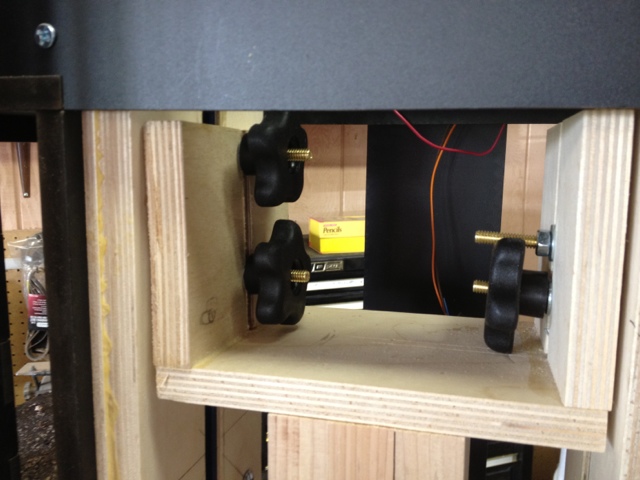


- We removed the outer legs to allow for the center leg drop track and figured out where to drill holes for the power wires from the batteries and foot drives.
- We installed the tracks for the center leg drop into the frame.
- We trimmed the center leg and added a trial L-shaped wooden bracket that will allow for the leg to be positioned on the tracks.
- We sanded down the excess resin on the new radar eye (that'd be the one to replace the first radar eye I messed up with a bad paint job)
- We cemented most of the styrene center foot together.
- We assembled the new metal foot drives, adjusted them and tested them.
Sunday, May 13, 2012
Forstner bits
This is my new favorite tool for the next couple of days: the Forstner bit.
.JPG)
Wikipedia, which is always true, all the time (right? right?) says Forstner bits are named after Benjamin Forstner, who invented them in the 1800s. They don't drill their holes so much as plane them with radial cutting edges that scrape and scrape in a circular pattern. Gunsmiths liked them, Wikipedia says, because they can drill very smooth holes.
I like them for that reason and because they are an example of a noun properly capitalized (in this case because they are named after a person). That's the copy editor in me speaking.
They've been useful in making large holes for some of R2-D2's parts, including some pieces for the styrene foot shell I cut today while my father was working on a center-leg drop design.. Here's a Forstner bit cutting a hole for the second foot drive, with my father at the drill press:
.JPG)
Wikipedia, which is always true, all the time (right? right?) says Forstner bits are named after Benjamin Forstner, who invented them in the 1800s. They don't drill their holes so much as plane them with radial cutting edges that scrape and scrape in a circular pattern. Gunsmiths liked them, Wikipedia says, because they can drill very smooth holes.
I like them for that reason and because they are an example of a noun properly capitalized (in this case because they are named after a person). That's the copy editor in me speaking.
They've been useful in making large holes for some of R2-D2's parts, including some pieces for the styrene foot shell I cut today while my father was working on a center-leg drop design.. Here's a Forstner bit cutting a hole for the second foot drive, with my father at the drill press:
Aluminum work
These videos are of my father making the necessary cuts and holes for the second aluminum foot drive on Saturday, May 5, 2012. He is using woodworking tools. The only special equipment used for a heavy-duty metal brake that a neighbor contractor handled and gloves.
Dealing with aluminum turned out to be not much more difficult than working with wood.
Enjoy!
Dealing with aluminum turned out to be not much more difficult than working with wood.
Enjoy!
Subscribe to:
Posts (Atom)